
Inverted Pendulum on a Cart: Modelling, PID Control and Simscape Validation
Published:
Course project, Dynamics · Ashesi University × ETH Zürich · October 2026 Tools: MATLAB, Simulink, Simscape Multibody, SolidWorks, Control System Toolbox
Overview
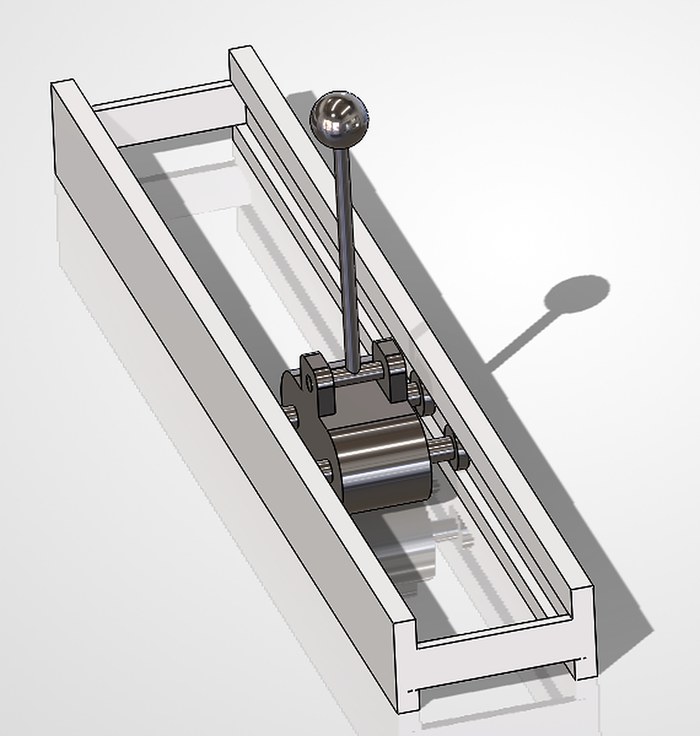
An inverted pendulum on a cart is unstable: left alone it falls. I modelled the system from first principles, designed a PID controller that keeps the pendulum upright, and checked the analytical model against a physics-based simulation built directly from my SolidWorks CAD assembly.
- Analytical model: equations of motion from the Lagrangian, linearised about the upright position, as a state-space model and transfer function. The upright position has an unstable pole at +4.72 rad/s.
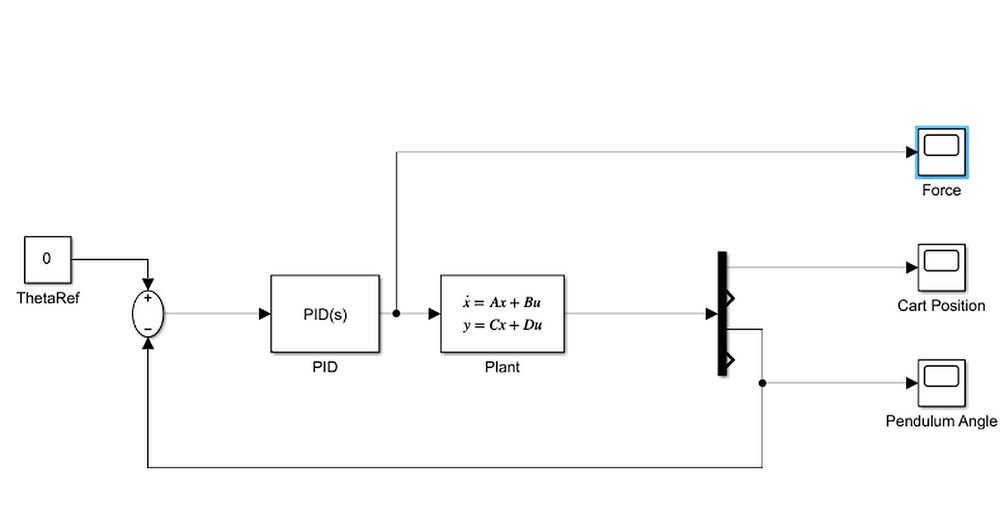
- Control design: a PID controller with a filtered derivative, tuned for a 60° phase margin and simulated on both the linear and nonlinear models in Simulink.
- CAD validation: the SolidWorks assembly was imported into Simscape Multibody with the same controller, and the two models were run from the same initial tilt (1.37°).
Results
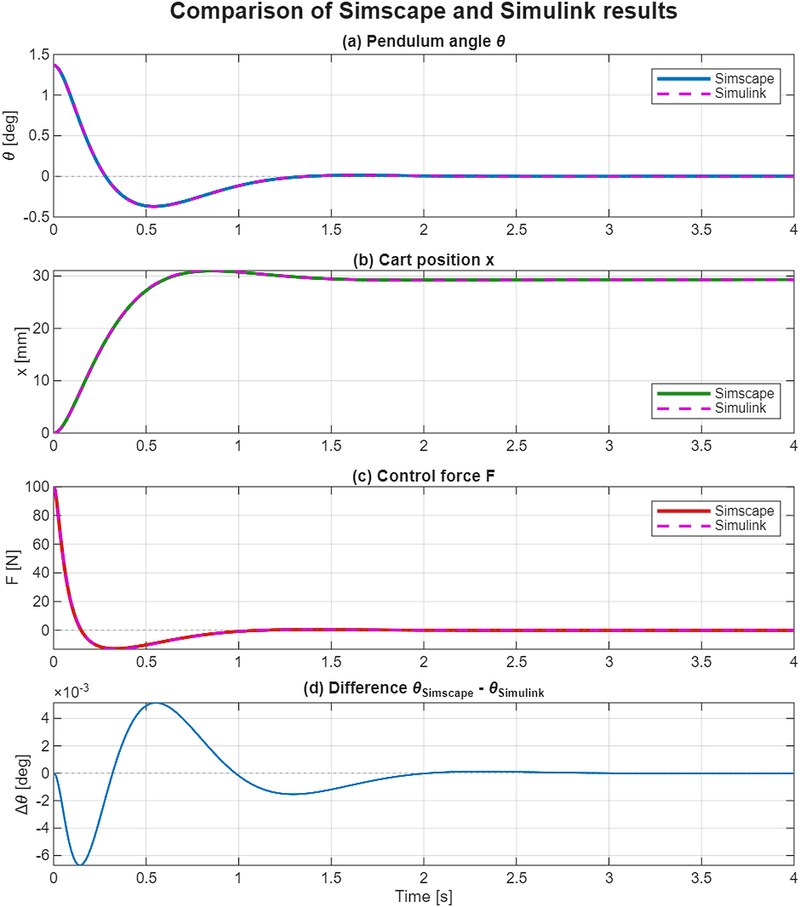
The controller brings the pendulum upright in about 1.2 s, with a peak force of 100 N, and stays stable for ±20 % changes in pendulum and cart mass. The analytical and CAD-based models agree to within 0.0067° in pendulum angle:
| Metric | Simulink (analytical) | Simscape (CAD) |
|---|---|---|
| Settling time (2 %) | 1.219 s | 1.224 s |
| Undershoot past upright | 27.4 % | 27.1 % |
| Peak control force | 100.1 N | 100.0 N |
| Cart final position | 29.3 mm | 29.4 mm |
What I learned
- Turning a CAD assembly into a working multibody simulation: replacing the rigid welds from the import with a prismatic joint for the cart, and correcting the joint angle offset so that 0° means upright.
- Small modelling choices matter. The remaining difference between the models comes mostly from the wheels’ rotational inertia, which the analytical model includes and the CAD model leaves free to spin.
- A PID loop on the angle alone balances the pendulum but lets the cart drift after a disturbance. An outer loop on cart position (cascade control) or LQR fixes this, and is my next step.